Showing posts with label art. Show all posts

Thursday, October 29, 2009

Buried Alive

Click to enlarge
Buried Alive
Artist: Odd Nerdrum
1996
oil on canvas

Wednesday, October 28, 2009

The Smiling Spider

Click to enlarge
The Smiling Spider
Artist: Odilon Redon (1840-1916)
1881
charcoal on paper
Musee du Louvre, Paris

Tuesday, March 31, 2009

Joshua Hoffine, Horror Photographer

Wolf
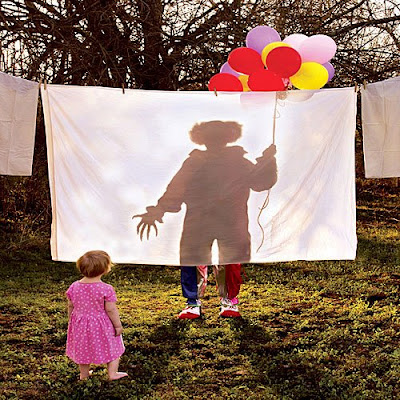
Joshua Hoffine is a horror photographer who has recently been featured in both Rue Morgue magazine and Fangoria. He left a career as a wedding photographer to capture images illuminating the darker side of our psyche, exposing our childhood nightmares and fears.


Balloons
Hoffline insists that the images be as real as possible, and that includes the children in the photographs. They're actually his real life daughters Anna (12), Shiva (10), Sade (5), and his main model Chloe (7).

Bedside
The series, called After Dark, My Sweet, is still in progress and can be viewed at his website, where you can also purchase prints.

Monday, March 30, 2009

Come Now, My Child

Come now, my child if we were planning to harm you, do you think we'd be lurking here beside the path in the very darkest part of the forest?          (click to enlarge)
Picture poem by Kenneth Patchen

Saturday, January 31, 2009

Danger on the Stairs


Danger on the Stairs
Artist: Pierre Roy
French
1927 - 1928
oil paint on canvas
Museum of Modern Art, NY
Gift of Abby Aldrich Rockefeller

Friday, November 21, 2008

Vampire


The movie Twilight opens today, so it seems appropriate to post a painting of dark romance.

"Vampire" was painted in 1893-4 by Edvard Munch, whose works also include "The Scream".

This painting was originally titled "Love and Pain". A critic mistakenly interpreted it, and the painting became commonly known thereafter as "Vampire". The woman in the painting is actually consoling her lover, not sucking his blood. Although...

Wednesday, October 29, 2008

Edgar Allan Poe Stamp

Edgar Allan Poe will be featured on a U.S. postage stamp early in 2009, the U.S. Postal Service said last Thursday.

The 42-cent stamp will mark the 200th anniversary of the birth of the poet and mystery writer and will be issued Jan. 16 in Richmond, Va.

This 3-cent stamp was issued in 1949, the one-hundreth anniversary of Poe's death. The portrait was based on the engraving by F. T. Stuart.

Sunday, October 19, 2008

Struwwelpeter

Purchase from Barnes & Noble
Merry Stories and Funny Pictures

(Fearful Stories & Vile Pictures To Instruct Good Little Folks)

Der Struwwelpeter (1845) is a popular German children's book by Heinrich Hoffmann which has been translated into English. It comprises ten illustrated and rhymed stories, mostly about children. Each has a clear moral that demonstrates the disastrous consequences of misbehavior in an exaggerated way. The title of the first story provides the title of the whole book. Literally translated, Struwwel-Peter means Shaggy-Peter.

Project Gutenberg has published an online eBook of Struwwelpeter with the author's original artwork.

In 1999 Feral House published a 15-story version of the book with illustrations by Sarita Vendetta. The prominent notice on the back cover, warning that this one-hundred-and-fifty-year-old children's book as presently conceived is not for children, is truly on the mark; Vendetta's sensual, erotic, deeply disturbing art is nightmarish.

Stories in the original version (with a couple of Vendetta illustrations from the Feral House version):

"Struwwelpeter" (Shaggy Peter) describes a boy who does not groom himself properly and is consequently unpopular.

In "Die Geschichte vom bösen Friederich" (The Story of Cruel Frederick), a violent boy terrorizes animals and people. Eventually he is bitten by a dog, who goes on to eat the boy's sausages while he is bedridden.

In "Die gar traurige Geschichte mit dem Feuerzeug" (The Dreadful Story of Pauline and the Matches), a girl plays with matches and burns to death.

In "Die Geschichte von den schwarzen Buben" (The Story of the Inky Boys), Nikolas (that is, Saint Nicholas) catches three boys teasing a dark-skinned boy. To teach them a lesson, he dips the three boys in black ink, to make them even darker-skinned than the boy they'd teased.

"Die Geschichte von dem wilden Jäger" (The Story of the Wild Huntsman) is the only story not primarily focused on children. In it, a rabbit steals a hunter's rifle and eyeglasses and begins to hunt the hunter. In the ensuing chaos the rabbit's child is burned by hot coffee.

In "Die Geschichte vom Daumenlutscher" (The Story of Little Suck-a-Thumb), a mother warns her son not to suck his thumbs. However, when she goes out of the house he resumes his thumb sucking, until a roving tailor appears and cuts off his thumbs with giant scissors.

"Die Geschichte vom Suppen-Kaspar" (The Story of Kaspar who did not have any Soup) begins as Kaspar, a healthy, strong boy, proclaims that he will no longer eat his soup. Over the next five days he wastes away and dies.

In "Die Geschichte vom Zappel-Philipp" (The Story of Fidgety Philip), a boy who won't sit still at dinner accidentally knocks all of the food onto the floor, to his parents' great displeasure.

"Die Geschichte von Hans Guck-in-die-Luft" (The Story of Hans Look-in-the-Air) concerns a boy who habitually fails to watch where he's walking. One day he walks into a river; he is soon rescued, but his portfolio drifts away.

In "Die Geschichte vom fliegenden Robert" (The Story of Flying Robert), a boy goes outside during a storm. The wind catches his umbrella and sends him to places unknown, and presumably to his doom.

Wednesday, September 24, 2008

Creepy, Eerie, and Vampirella


Back when I was a kid in the 70's, those were the comic mags we read whenever we needed a quick horror fix . You can check out some of the artwork at the Warren Magazine Collection, an online repository of Warren comic and magazine covers.

Tuesday, September 23, 2008

Memento mori

Memento mori is a Latin phrase that may be translated as "Remember that you are mortal," "Remember you will die," "Remember that you must die," or "Remember your death". It names a genre of artistic creations that vary widely from one another, but which all share the same purpose, which is to remind people of their own mortality.


Still Life With a Skull
Artist: Philippe de Champaigne
France
circa 1671

Sunday, September 21, 2008

The Scream

Click to enlarge
The Scream (Skrik, 1893-1910) is a seminal series of expressionist paintings by Norwegian artist Edvard Munch, depicting an agonised figure against a blood red sky. The landscape in the background is Oslofjord, viewed from the hill of Ekeberg, in Oslo (then Kristiania), Norway.

Munch created several versions of The Scream in various media. The National Gallery of Norway holds one of two painted versions (1893, shown above). Munch Museum holds the other painted version (1910, shown below) and one pastel. A fourth version, in pastel, is owned by Norwegian billionaire Petter Olsen. Munch also created a lithograph (1895, shown below) of the image.

Click to enlarge Click to enlarge

In a page in his diary headed Nice 22.01.1892, Munch described his inspiration for the image thus:

"I was walking along a path with two friends—the sun was setting—suddenly the sky turned blood red—I paused, feeling exhausted, and leaned on the fence—there was blood and tongues of fire above the blue-black fjord and the city—my friends walked on, and I stood there trembling with anxiety—and I sensed an infinite scream passing through nature.”

The reddish sky in the background was possibly caused by the aftermath of the powerful volcanic eruption of Krakatoa in 1883. The ash that was ejected from the volcano left the sky tinted red in much of eastern United States and most of Europe and Asia from November 1883 to February 1884.

Skeletons Warming Themselves

Click to enlarge
Skeletons Warming Themselves
Artist: James Ensor
Belgium
1889