... one giant leap for mankind. As I'm sure everyone knows, 40 years ago today man landed on the moon.
Here's a great site for the 40th anniversary of Apollo 11:
We Choose the Moon
It's DEFINITELY recommended!
The First Men in the Moon (1901) is one of the most dazzling of H.G. Wells's "scientific romances," and the last of the series which began with The Time Machine. Leaving their humdrum lives in Kent, Mr. Bedford and Mr. Cavor invade the moon and are captured by the ant-like Selenites. They are forced to confront their own littleness when viewed in a cosmic perspective, and the result is a highly entertaining satire on imperialism in particular and human frailty in general.
Here's the trailer for the movie:
Showing posts with label 60's. Show all posts
Showing posts with label 60's. Show all posts
Monday, July 20, 2009


Friday, March 27, 2009
Friday Nights Frights: The Valley of Gwangi (1969)

Welcome to tonight's episode of Friday Night Frights.
Last week we had soldiers and werewolves, this week we have cowboys and dinosaurs!
Tonight's feature is a classic dinosaur movie from 1969, with some great stop-motion special effects by the genius Ray Harryhausen. I remember loving this on TV when I was a kid.
The Valley of Gwangi was directed by Jim O'Connolly; the cast includes James Franciscus, Gila Golan, Richard Carlson, and Laurence Naismith.
Cowboy James Franciscus seeks fame and fortune by capturing an Allosaurus living in the Forbidden Valley and putting it in a Mexican circus. Guess what happens?
Here's the full movie, in a playlist:
Monday, March 16, 2009
Bambi Meets Godzilla (1969)
Bambi Meets Godzilla was written, directed and (as you'll see) everything else by Marv Newland.
This cartoon prefaced Godzilla 1985 on New World Pictures' VHS release, but was omitted when that film was licensed to Starmaker.
For those interested, the background music is "Ranz Des Vaches", from Gioacchino Rossini's William Tell. The loud, elongated piano chord is the final note of "A Day in the Life" from "Sergeant Pepper's Lonely Hearts Club Band" by The Beatles.
Saturday, February 7, 2009
Yellow Submarine (1968)

On this day in 1964 the Beatles arrived at JFK International Airport to begin their first tour of the United States.
Which brings to mind their movie, Yellow Submarine.
What does this have to do with horror? The Blue Meanies!!!
Weapons and species of Meanie (SPOILER ALERT)
- The Common Blue Meanies: These, it seems, are a sub-species of their Chief's origin. They wear navy blue woolly coats, domino masks, and Mickey Mouse-ear-like hats (with the exception of the Chief Blue Meanie himself and his sidekick "Max", whose hats look more like Goofy's ears). They have six claws on each hand, and wear yellow-and-orange striped tights (again, the Chief and Max are the exceptions here, as they both wear jackboots with spurs: light blue boot on the right foot, navy blue on the left). They are also able to make their eyes glow so that they can see in the dark, which makes the head resemble a video projector. These particular Meanies carry guns that fire pale-blue jagged arrows which, on contact, drain the victim's colour and petrifies him or her - although it seems to varying degrees or only temporarily, because several victims in the film are seen to cry, smile, or look up, and several natives of Pepperland are seen to back off at the sight of the Flying Glove (see below).
- The Apple Bonkers: These are tall, thin Meanies who can walk from hill to hill at a stride. Their weapons of choice are giant Baldwin apples, which they drop on people's heads and which have the same effect of the jagged arrows. If one can reach high enough, they too can be knocked out by such weapons, as the Beatles later discover. When seen closely, their faces bear a near striking resemblance to Abraham Lincoln.
- The Butterfly Stompers: These are wide, bullying Meanies with cat-like faces. They each carry a number on their chest, and for whatever reason they find it entertaining to destroy butterflies. One of them also stomps upon Max's head at the Chief's behest.
- The Countdown Clowns: These are tall, fat Meanies whose heads can spin round and round, and who shriek very loudly when ready to attack, or when they feel the need to alert other Meanies. If their noses are pressed, wherever they look there will appear an explosion. They have no hands or arms themselves, however, and so another Meanie has to press their noses for them, often needing to prop a ladder up against them, or sit up on their shoulders when doing so, because they are tall. When the Meanies' spell is broken, they end up simply producing positive words such as "Yes" and "OK" in block capitals when they try to cause an explosion.
- The Hidden-Persuader Men: These are large, fat Meanies who are constantly smoking cigars and carrying martinis which appear to have eyes on the glass. These men appear to be harmless, but upon closer inspection, they have an extra hand inside their shoes, which typically wields a pistol and shoots whenever the toe of the shoe is raised. If the shoe is closed at the right time, however, they can be made, quite literally, to shoot themselves in the foot. They are one of the rarest seen Meanies. When the Meanies' spell is broken, we see them proposing toasts to each other and using their third hands to shake.
- The Snapping-Turtle Turks: Possibly the most pettily cruel of the Meanies, and dressed like stereotypical Turkish men (though otherwise incomparable). These are comparatively short Meanies, but are fat, and their stomachs are in fact oversized, predatory faces whose sharp-toothed mouths consume objects. We see one of these eating a little girl's paper windmill on purpose to make her cry.
- The Jack-the-Nippers: These are tall, muscular Meanies who wear green tail-coats and sunglasses and have reptilian heads for hands. Much like the Snapping-Turtle Turks' stomachs, these hands are used for fierce biting, but if startled can bite their own tongues, causing extreme pain. They are the least frequently seen of all the Meanies. The name is a play on Jack the Ripper.
- The Four-Headed Bulldog: There is possibly just one of these, but that hardly matters, as it has four heads, each with very sharp teeth. It is extremely strong, and its handler is no match for it if it wishes to walk in a particular direction. It is ultimately defeated when the Beatles and their doubles, the Sgt. Pepper's Lonely Hearts Club Band, sing "Hey Bulldog" and run in opposite directions to disorientate it.
- The Dreadful Flying Glove: The Chief's fiercest and strongest fighter. Though there is only one glove, it is a force to be reckoned with; crushing, squashing, or "o-blue-terating" whoever or whatever its master directs it to attack. It has a stylized face, with the thumbnail acting as the eye and the index finger as the nose. As it clenches itself into a fist, it covers up its eye, temporarily blinding it. It is ultimately defeated when John sings "All You Need is Love" and covers it with the letters of all the words that spring from his mouth as he sings.
The Beatles agree to accompany Captain Fred in his Yellow Submarine and go to Pepperland to free it from the music hating Blue Meanies.
Some source material from this Wikipedia article.
Friday, January 2, 2009
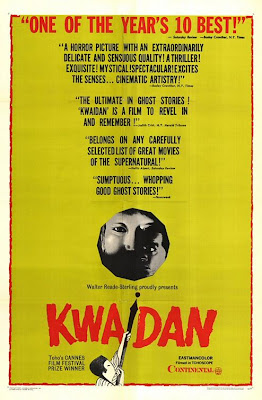
Friday Night Frights: Kaidan (1964)
Welcome to tonight's episode of Friday Night Frights.
Tonight's feature is the Japanese horror classic Kaidan (aka Kwaidan), directed by Masaki Kobayashi.
This horror anthology contains four separate stories.
"Black Hair": A poor samurai who divorces his true love to marry for money, but finds the marriage disastrous and returns to his old wife, only to discover something eerie about her.
"The Woman in the Snow": Stranded in a snowstorm, a woodcutter meets an icy spirit in the form of a woman spares his life on the condition that he never tell anyone about her. A decade later he forgets his promise.
"Hoichi the Earless": Hoichi is a blind musician, living in a monastery who sings so well that a ghostly imperial court commands him to perform the epic ballad of their death battle for them. But the ghosts are draining away his life, and the monks set out to protect him by writing a holy mantra over his body to make him invisible to the ghosts. But they've forgotten something.
"In a Cup of Tea": A writer tells the story of a man who keep seeing a mysterious face reflected in his cup of tea.
Part of what makes this film so special is the combination of wonderful cinematography - and a remarkable set design schema. The colors in this film are incredibly hot and emphatic.
Cannes Film Fesival winner in 1965 -Jury Special Prize.
Nominated for an Oscar in 1966 for Best Foreign Language Film -Japan.
Thursday, December 25, 2008
Santa Claus Conquers the Martians (1964)

MERRY CHRISTMAS!
The Martians kidnap Santa because there is nobody on Mars to give their children presents.
Santa Claus Conquers the Martians shows up frequently on lists of all-time bad movies, which naturally makes it prime fodder for MST3K. That version is included here as well. Happy Holidays!
Original version
MST3K presentation
Wednesday, December 17, 2008
The Twilight Zone - The Night of the Meek (1960)

The Night of the Meek, written by Rod Serling, originally aired on December 23, 1960. It was Episode 11 of Season 2 of "The Twilight Zone".
Christmas in the Twilight Zone! Art Carney (Ed Norton of "The Honeymooners") is a forlorn department store Santa who takes to drinking - only to find himself experiencing the nicest Christmas ever!
Wednesday, December 10, 2008
How the Grinch Stole Christmas (1966)

How the Grinch Stole Christmas, written by Dr. Seuss and animated by Chuck Jones, is appropriate for this blog for two reasons:
First of all - The narrator and voice of the Grinch is Boris Karloff.
Second of all - The Grinch! A vile, foul monster! Remember?
You're a vile one, Mr. Grinch / You have termites in your smile / You have all the tender sweetness of a seasick crocodile / Mr. Grinch / Given the choice between the two of you, I'd take the... seasick crocodile.
You're a foul one, Mr. Grinch / You're a nasty, wasty skunk / Your mind is filled with unwashed socks, your soul is full of gunk / Mr. Grinch / The words that best describe you are as follows, and I quote: Stink, stank, stunk!
You're a monster, Mr. Grinch / Your heart's an empty hole / Your brain is full of spiders, you have garlic in your soul / Mr. Grinch / I wouldn't touch you with a thirty-nine-and-a-half foot pole.
Your soul is an apalling dung-heap, overflowing with the most disgraceful assortment of deplorable rubbish imaginable, mangled up in tangled up knots.
The famous Grinch song was sung by Thurl Ravenscroft, perhaps better known as the voice of Tony the Tiger in the TV commercials. He received no screen credit for his singing, an oversight Dr. Seuss attempted to rectify by sending letters to every major columnist in America identifying Ravenscroft as the singer on "You're a Mean One, Mr. Grinch". He is also part of the chorus on the other two songs.
Sunday, November 30, 2008
The American Nightmare (2000)

The American Nightmare, a documentary directed by Adam Simon, examines the nature of 1960's-70's horror films, the involved artists, and how they reflected contemporary society.
The film features interviews with John Carpenter, Wes Craven, David Cronenberg, Tobe Hooper, John Landis, George A. Romero, and Tom Savini, among others.
WARNING - CONTAINS SCENES OF EXTREME HORROR
Full documentary, from a playlist:
Friday, October 31, 2008
Friday Night Frights: Night of the Living Dead (1968)
HAPPY HALLOWEEN!

They're coming to get you, Barbra!
Welcome to tonight's episode of Friday Night Frights.
Tonight's feature is the one that started it all. Night of the Living Dead is the classic genre-spawning 1968 horror film directed by zombie master George A. Romero.
The plot revolves around the mysterious reanimation of the dead and the efforts of Ben, Barbra and five others to survive the night while trapped in a rural Pennsylvania farmhouse. Chaos descends as the bodies of the recently deceased inexplicably return to life and feed on human flesh. The only way to destroy the zombies is to destroy the brain!
Night of the Living Dead was awarded two honors thirty years after its debut. The Library of Congress added it to the National Film Registry in 1999 with other films deemed "historically, culturally or aesthetically important in any way." In 2001, the American Film Institute named the film to a list of one hundred important horror and thriller films.
Tuesday, October 21, 2008
Halloween - Addams Style
Here's an episode of The Addams Family that first aired on October 29, 1965.
Gomez and Morticia are outraged when Wednesday comes home from trick-or-treating in tears after a neighbor tells her witches don't really exist.

Gomez and Morticia are outraged when Wednesday comes home from trick-or-treating in tears after a neighbor tells her witches don't really exist.
Monday, October 20, 2008
Bewitched - Trick or Treat
Here's an episode of Bewitched that first aired on October 28, 1965.
When Darrin defies Endora again by insisting Samantha remain at home during Halloween, Endora places a curse on Darrin that slowly begins transforming him into a werewolf.

When Darrin defies Endora again by insisting Samantha remain at home during Halloween, Endora places a curse on Darrin that slowly begins transforming him into a werewolf.
Thursday, October 16, 2008
The Jupiter 2 Will Lift Off 11 Years Ago Today

In the television show Lost in Space, the spaceship Jupiter 2 lifted off on October 16, 1997. To us kids in the 60's, when this show aired, that was so far out in the future that it was believable.
There were two pilot episodes for this liftoff. The original pilot episode (No Place To Hide), which never aired, did not feature either the robot or Dr. Smith (who was added later by 20th Century Fox as an antagonist), and the ship was named the Gemini 12. Much of the original footage was re-used in the first four televised episodes.
Watch No Place To Hide.
The first televised episode (The Reluctant Stowaway) aired on September 15, 1965. This pilot included Robot B9 and an evil Dr. Zachary Smith.
Watch The Reluctant Stowaway.
Sunday, October 12, 2008
The Birds: The Birds Amass, The Children Run
I still get an uneasy feeling whenever I see a flock of birds massing together, because of this scene in the 1963 movie The Birds, directed by Alfred Hitchcock.
Cause here's what can happen.
Cause here's what can happen.
Tuesday, October 7, 2008
It's the Great Pumpkin, Charlie Brown (1966)
Since it's October, it's time for the yearly showing of It's the Great Pumpkin, Charlie Brown. While not exactly horror per se, it is Halloween themed, and what's more - at 1:32 into the tale Lucy approaches Linus clutching a butcher knife in her fist.
Monday, September 29, 2008
The Alfred Hitchcock Hour

The Alfred Hitchcock Hour ran from 1962-1965 for 93 hour-long episodes. It was a continuation of the dramatic anthology series, Alfred Hitchcock Presents (1955-1962), hosted by the master of suspense and mystery. When the series was revived in 1962, episodes were extended to a full hour instead of 30 minutes and the name was changed, but the format stayed fairly true to the original. In each episode, viewers would be strung along with the story, never knowing which way the final twist would turn.
You can view full episodes of the series here.
Thursday, September 18, 2008
The Lottery
One of my favorites, "The Lottery" is a short story by Shirley Jackson, first published in the June 26, 1948 issue of The New Yorker.
The magazine and Jackson herself were surprised by the highly negative reader response. Many readers cancelled their subscriptions, and hate mail continued to arrive throughout the summer. In South Africa the story was banned. Since then, it has been accepted as a classic American short story, subject to many critical interpretations and media adaptations.
Larry Yust's short film, The Lottery (1969), produced as part of Encyclopædia Britannica's "Short Story Showcase" series, was ranked by the Academic Film Archive "as one of the two bestselling educational films ever". It features the film debut of Ed Begley, Jr.
Wednesday, September 17, 2008
The Child Molester (1964)
Produced by the Highway Safety Foundation in 1964, The Child Molester is a shocking film that deals with a subject quite taboo
for its time. The short serves as a dramatized warning,
ending with graphic case studies. Unlike the driver's education
films produced by the same company, this film was apparently
issued for only a short time before being withdrawn.
I think I was in the fourth or fifth grade, around 1969, when I saw it during an assembly in the school cafeteria.
It terrified us.
CONTENT ADVISORY: Graphic crime scene footage at end
Tuesday, September 16, 2008
Dark Shadows
"My name is Victoria Winters... my journey is just beginning..."
On 27 June 1966, those words began the journey of a young governess to the remote coastal town of Collinsport, Maine, which for the next five years would be the home of the assorted supernatural forces inhabiting the world of ABC-TV's Dark Shadows, the first gothic soap opera.
Created by Dan Curtis, this show ran for 1245 episodes. As a kid in the 60's, I'd hurry home after school so I wouldn't miss the beginning. The show featured vampires, witches, werewolves - everything that kept me glued wide-eyed in front of the set.
Here's a scene in which Willy Loomis, handyman, discovers a secret room in the Collins Mausoleum.
Subscribe to:
Posts (Atom)


